Why Kimi Antonelli Beat George Russell Across F1’s 2026 Season
Antonelli’s corner speed, tyre control and comfort with the 2026 Mercedes explain a 130-point title margin over Russell.
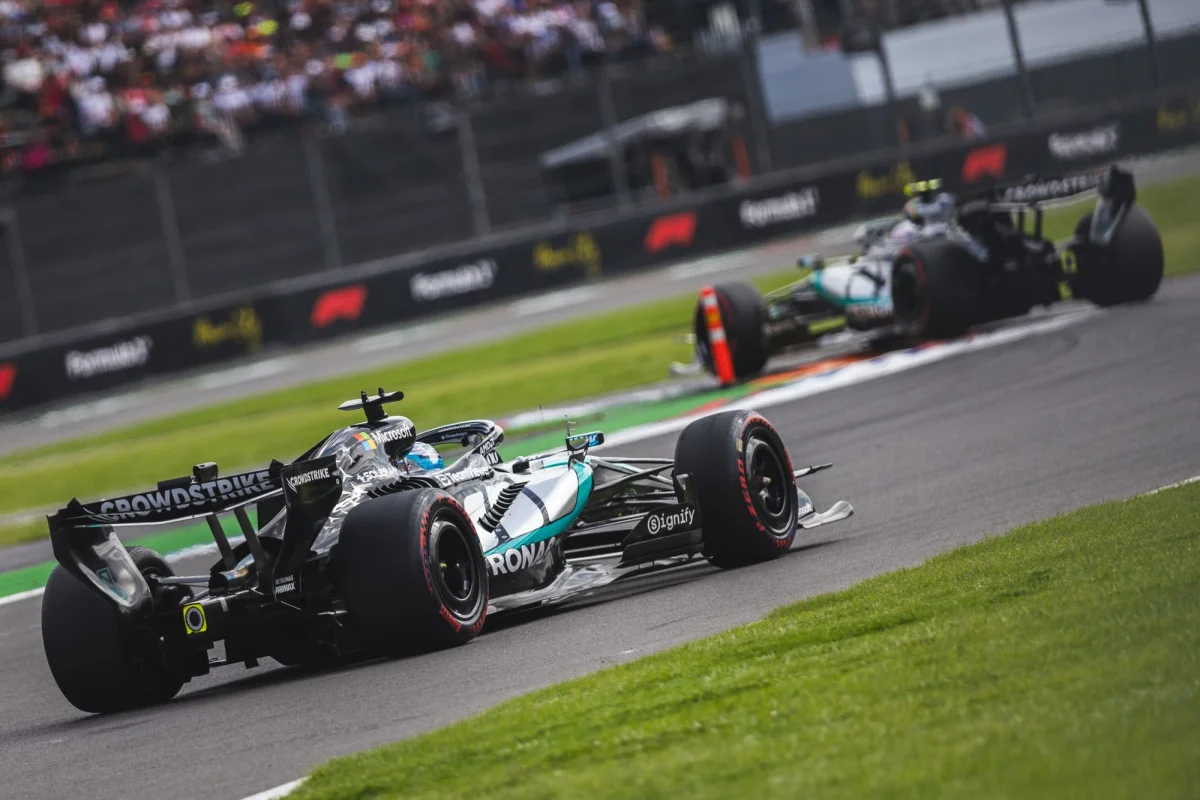
Kimi Antonelli’s 2026 title run exposed a gap between one-lap pace and race performance at Mercedes. George Russell could match or beat his team-mate on some Saturdays, but Antonelli was faster across most comparable race stints, managed the tyres better and won the championship with four rounds remaining.
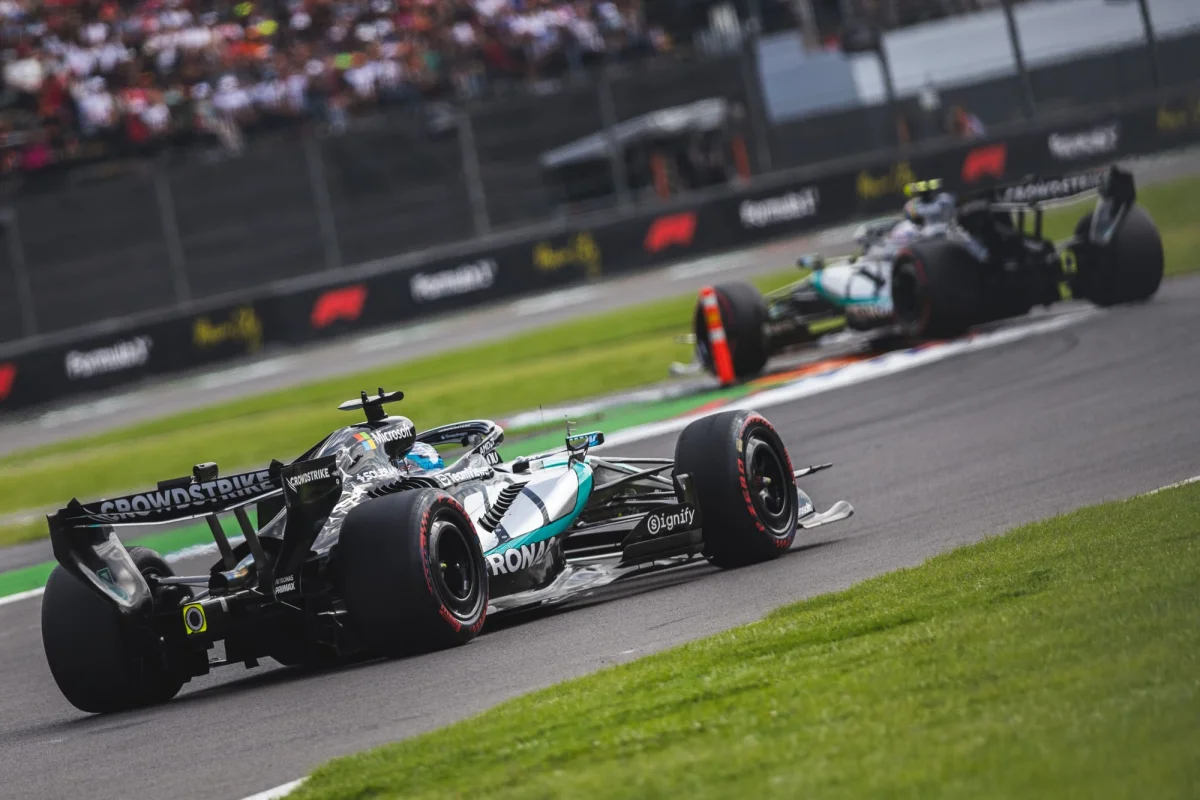
The scale of the result is striking. Antonelli won nine races to Russell’s three, took 16 podiums to Russell’s eight and finished 130 points clear. Russell, who had previously held his own against Lewis Hamilton over three seasons as team-mates, began the year with a dominant Australian Grand Prix. Mercedes looked well placed in the new rules era, and Russell’s early form suggested he could lead the team. Instead, his season became a search for an explanation he and the team have yet to pin down fully.
Saturday was close; Sunday wasn’t
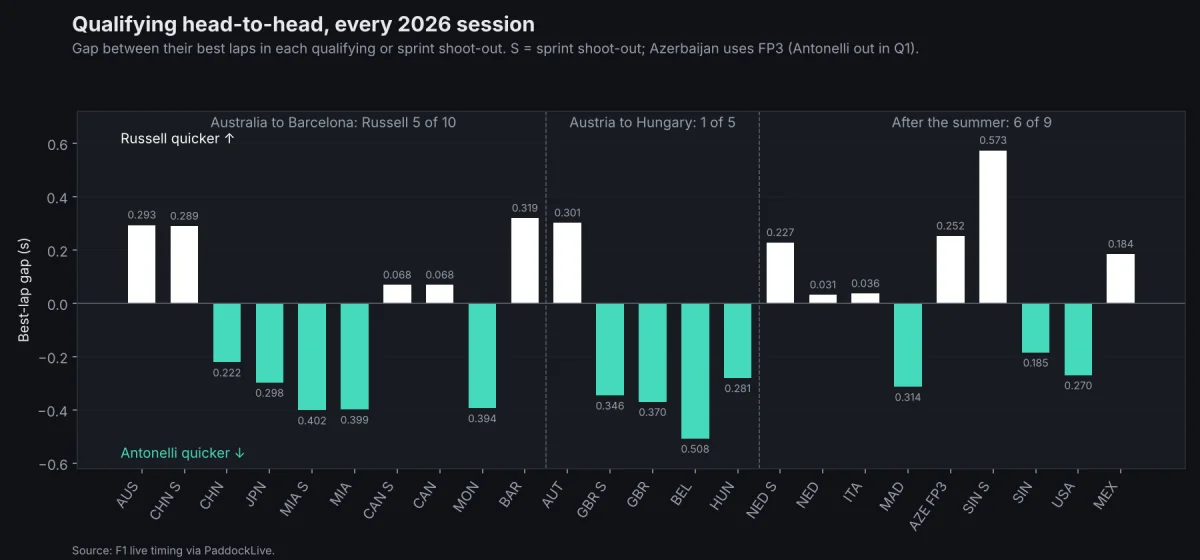
Across 109 comparable practice and qualifying sessions, Antonelli came out ahead 58 times and Russell 51. The gap was narrower when it mattered most in qualifying: Antonelli’s median advantage in Q3, or SQ3 at sprint events, was 0.185 seconds. Russell still took five poles to Antonelli’s seven, and led 10–9 on grand prix starts. He also had the slight edge in sprint qualifying.
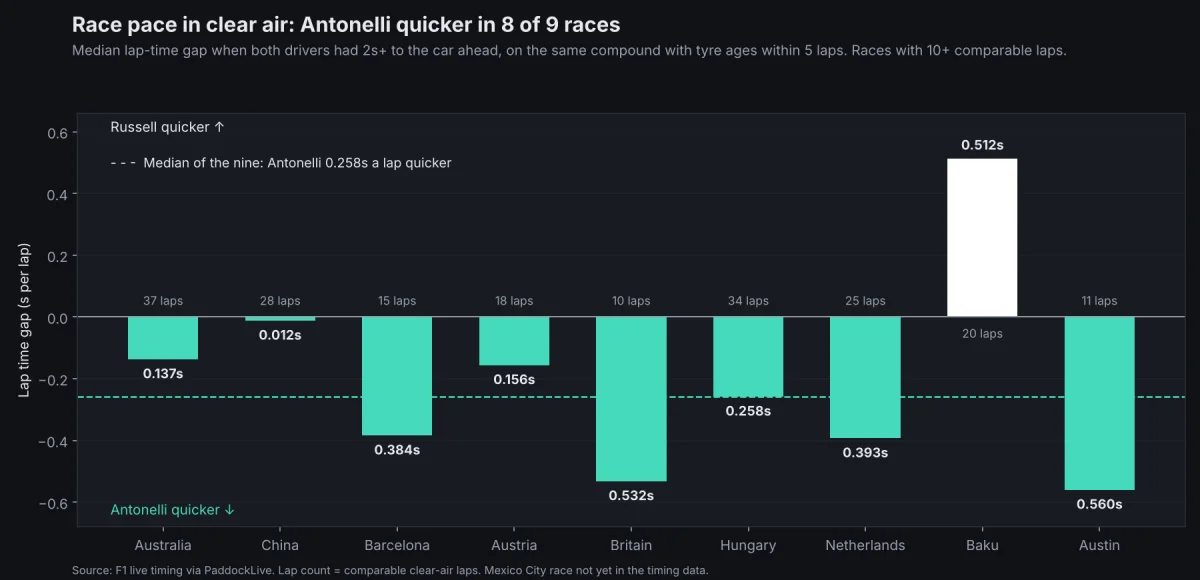
That makes the race results more revealing. To compare their pace, the analysis focused on laps in clear air, defined as at least two seconds behind the car ahead, while matching tyre compound and tyre age. Among nine races with enough comparable running, Antonelli was faster in eight, by roughly a quarter of a second per lap.
Baku was the exception. Russell won from pole there while Antonelli spent much of the race working through traffic after a qualifying crash. Track position clearly shapes the comparison, and Russell also bore more of Mercedes’ engine performance problems. Mexico was a conspicuous case, while he had separate issues at Silverstone and Spa that Antonelli did not encounter.
Even so, Antonelli’s advantage showed up over full stints, not just in clean qualifying laps. He spent long stretches lapping faster during Russell’s wins in Australia and Austria. The numbers point to a Sunday weakness for Russell that was more consequential than the relatively small qualifying gap: Antonelli could turn a modest pace edge into more consistent race results.
How the two drivers use a corner
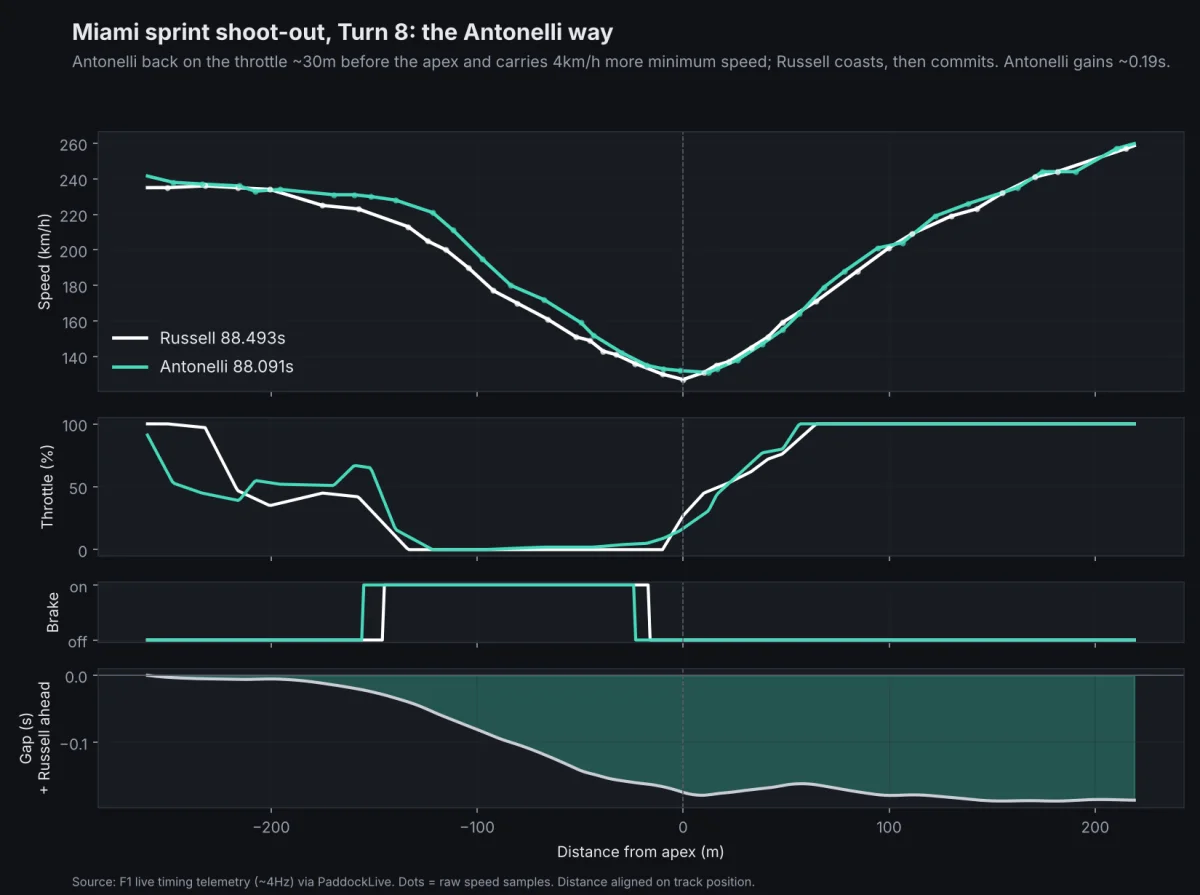
Russell describes his approach as prioritising early power. “I'm quite aggressive on the throttle pedal, and I focus a lot [on] getting on the power early,” he says. He characterises Antonelli as attacking the entry and applying power later. Lap data supports the broad distinction, though the details are less simple: Antonelli often picks up the throttle earlier too, but does it more gently, especially through faster turns.
Antonelli generally carries more speed from turn-in to the apex. He may brake later, or keep some brake pressure on deeper into the corner to help rotate the car. His sharper steering input also helps point it toward the exit. Russell tends to wait longer before committing to rotation, then uses a harder throttle application, particularly out of slower corners.
That difference can make Antonelli quicker through the middle of a turn without giving away as much on exit as might be expected. The 2026 cars move around more and offer less grip than their predecessors. Antonelli appears comfortable working with that movement, adjusting the brakes and throttle as the car slides. Russell’s more patient approach can leave him waiting for the car to rotate before he commits to power.
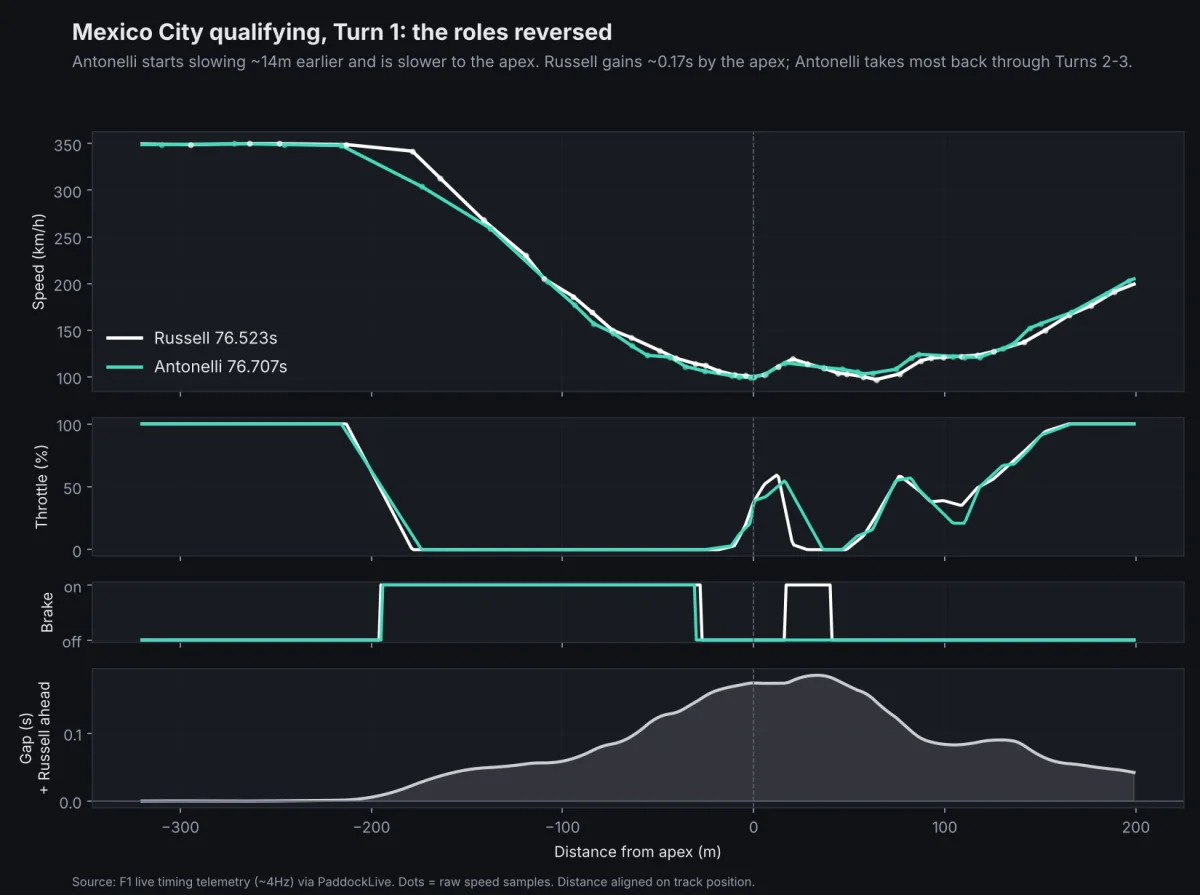
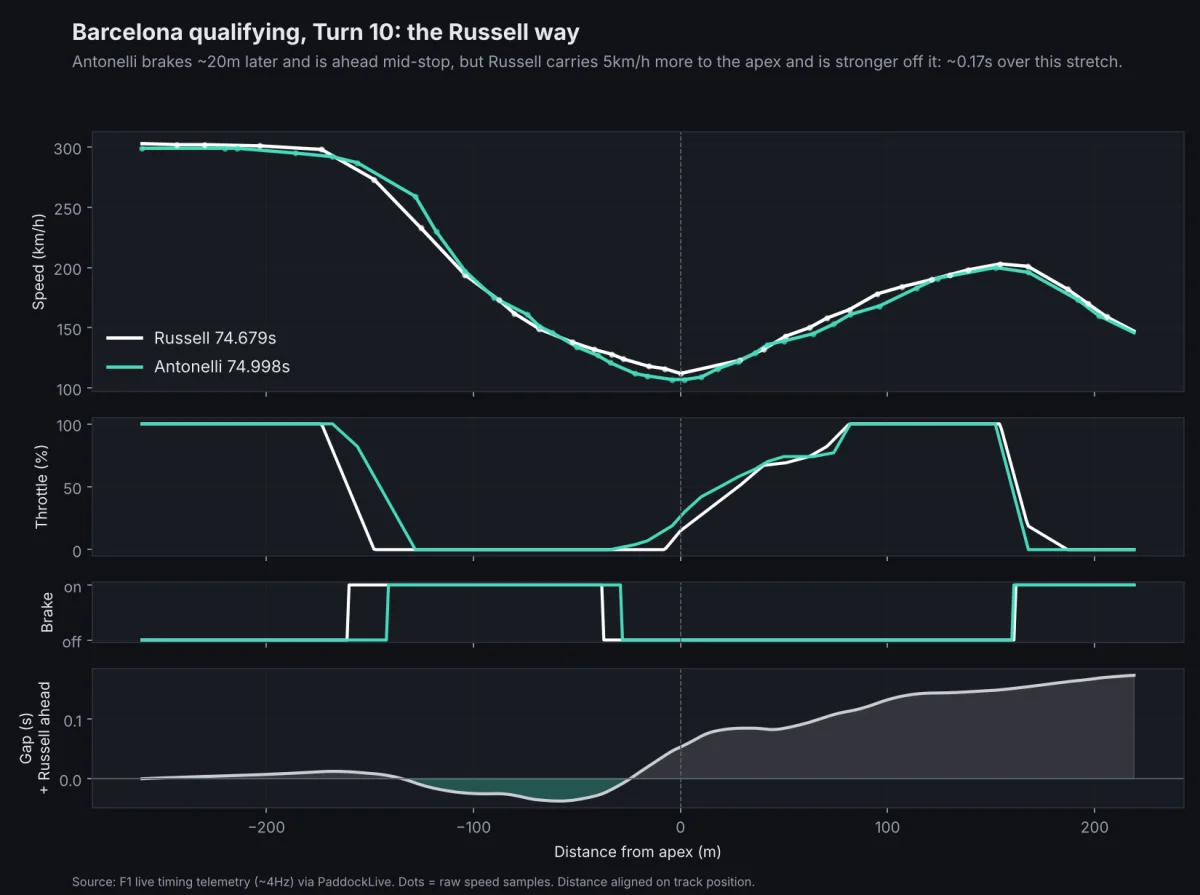
The pattern depends on the corner. Russell has often been as quick as, or quicker than, Antonelli through short, slow turns where there is less time spent coasting. Examples include Turn 3 in Melbourne, the China hairpin, Turn 3 in Austria and much of Baku. At Barcelona, where Russell took pole, he was particularly strong on the exit of the Turn 10 hairpin after giving up some ground on entry.
Longer entries and linked corners have more often suited Antonelli’s way of carrying speed. Across the 11 qualifying laps on which he was faster, he won the turn-in-to-apex phase 71% of the time. The typical gain was only a few hundredths of a second after accounting for the exit, but small differences add up over a lap. Antonelli had six qualifying wins by at least 0.35 seconds; Russell had one.
That pattern may also build on itself. A driver who trusts the car can attack the corners that suit him, while a particular circuit layout or a Mercedes setup may amplify one style. On weekends when confidence or car balance is missing, a small technical advantage can become harder to access.
Energy use and rear-tyre control
Driving style may also affect how effectively the 2026 power unit’s energy is used. In Austin, Antonelli carried more speed through the medium-speed turns in the first sector and used less throttle mid-corner. Russell applied more throttle there, which appeared to require more battery deployment on the short straight that followed. That left him with less energy available for the longer straight later in the lap, where the difference cost more.
The available data cannot establish how often that happened or how large the effect was across the season. Mercedes’ detailed battery information is not available for this analysis. Still, Austin was not an isolated example of the two drivers taking different routes through a lap, and Russell has argued that Antonelli’s approach better suits the engines.
Tyre management offers another part of the explanation. Antonelli has generally controlled rear-tyre slip well: he lets the car move enough to maintain corner speed without overworking the rear tyres. Russell has had laps where pace dropped away as he struggled to keep the rear in check. Across 14 directly comparable race stints, his lap times deteriorated faster with tyre age in nine.
Higher tyre pressures this year have tended to make the cars more limited by rear grip. That can penalise a driver who uses a harder throttle application either to rotate the car or to deliver power quickly. If the rear tyres slide, the driver loses traction and may need to ease the throttle to correct the movement.
“That has hindered me a little bit by pushing the exits,” Russell says. “The rear tyre can't cope with it as well.” A controlled exit can preserve pace over a single lap; across a race stint, keeping the tyres in better condition compounds the benefit.
Antonelli’s experience with these tyres differs from Russell’s, but the 2026 tyre behaviour also reset the challenge for both drivers. His race engineer, Peter Bonnington, previously spent years working with Lewis Hamilton, a driver known for tyre management. The source points to that background as a possible influence, though the direct cause of Antonelli’s advantage remains difficult to isolate.
A car that suits Antonelli
Antonelli’s performance is especially striking because the same driving tendencies were present in 2025, when they helped Russell more often. Russell outqualified him at 15 circuits last year; at seven of those same circuits in 2026, Russell came out ahead. Antonelli’s approach has become more pronounced, including picking up the throttle a few metres earlier, but the change in car behaviour appears central.
Mercedes’ 2025 car did not suit the way Antonelli likes to work the front axle, attack corner entries and manage rotation early. Its ground-effect aerodynamics generated enough downforce to mask some of the car’s underlying feel. When grip went, it could disappear abruptly, leaving little room to catch the car. That made it harder for Antonelli to trust his inputs, particularly after an unsettled first season in which his confidence was already fragile.
The 2026 Mercedes has less aerodynamic and mechanical grip. Many drivers dislike how much it moves, but Antonelli says the extra feel helps him judge the limit. He noticed the difference during the wet laps at Mercedes’ Silverstone shakedown. “I'm more in control of the situation,” he says.
That confidence has practical consequences. If Antonelli can read what the rear tyres and car are doing, he can commit to his sharper, more active approach. Mexico showed how much the result depends on that feeling: illness and the chance to clinch the title left him, by his account, without his usual intensity, and his normal qualifying advantage over Russell disappeared.
Russell has worked to move toward Antonelli’s style, but it seems less natural for him. His season has swung between weekends when he matches or beats his team-mate and others when he falls well behind. He can sometimes extract a strong qualifying lap even when Mercedes has not found its balance, then struggle to sustain that pace over a race stint. As Russell put it in Mexico, he has lacked average performances: he is either very good or off the pace, while Antonelli has kept a higher standard more consistently.
What changes next
Russell’s task is complicated by the fact that the next season’s cars will change the conditions behind this comparison. They are expected to lose downforce, the engines will change and energy deployment is expected to be less sensitive. The tyres are also set to become more limited by front grip, a change Russell believes could suit him better.
Those changes may shift the balance between their styles, but they do not explain away the present result. Antonelli adapted quickly to the 2026 car, sustained his pace over race stints and kept his rear tyres under control. Russell still showed he could produce top-level laps, yet his peaks were too sporadic to challenge for the title.
The clearest takeaway for Mercedes is that Russell needs to understand why his best performance has been so difficult to repeat, while Antonelli’s comfort with the car and tyres has made him the benchmark. The coming car changes could offer Russell a better fit; his winter work will determine whether that becomes a consistent advantage.