2027 Audi Q9 and SQ9 First Drive: Space, V8 Power and a Nimble Feel
Audi’s new Q9 brings a roomier three-row cabin and agile handling; the V8 SQ9 adds startling acceleration and sharper cornering.
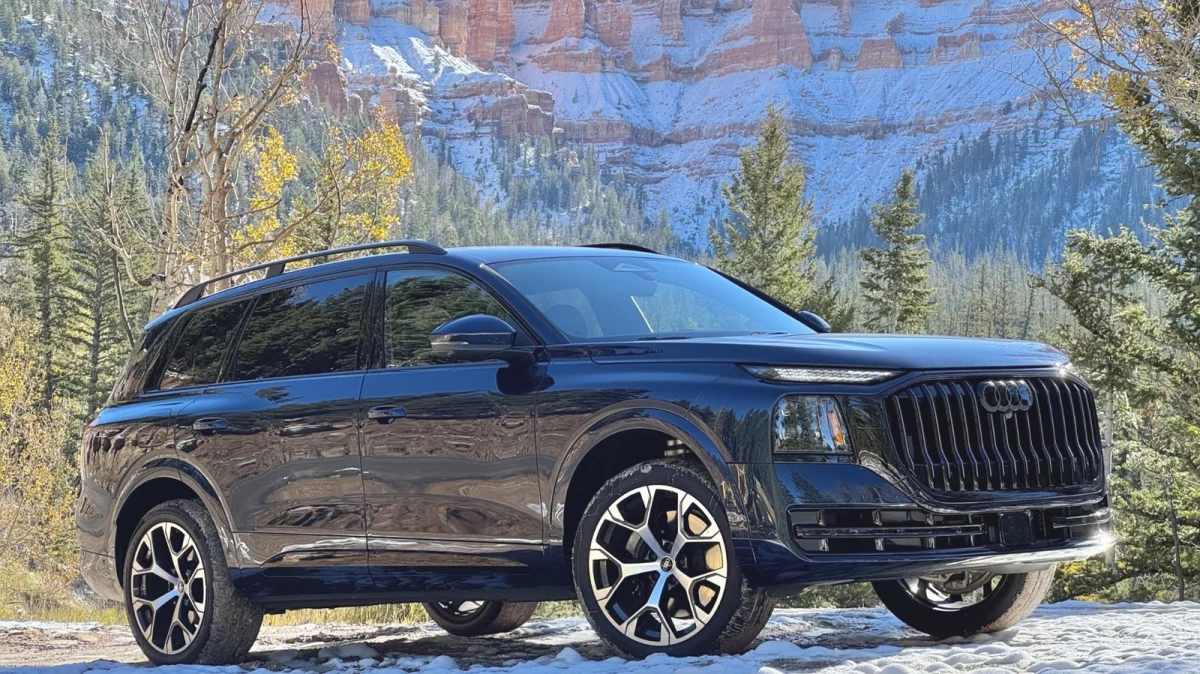
Audi’s new flagship three-row SUVs make a strong case for buyers who want family-sized space without the bulkier feel common in this class. The 2027 Q9 is a substantial step up in size from the redesigned Q7, while the V8-powered SQ9 turns the same formula into an unusually quick and composed luxury hauler. After driving both in Utah, I came away thinking Audi has found a compelling new role at the top of its range.
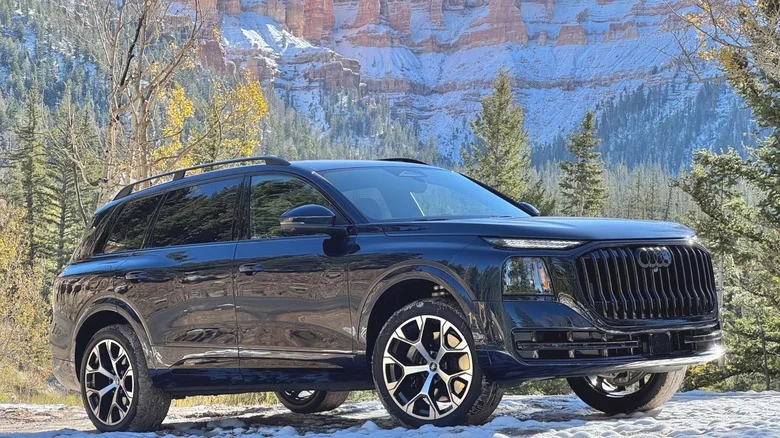
The Q7 helped define a more car-like, stylish approach to the European three-row SUV when it arrived in 2007, but its second generation has now been on sale for a decade and sits toward the small end of the segment. Audi is launching a larger Q7 for 2027, which I’ll review separately, and adding the Q9 as its new flagship. The Q9 and SQ9 are designed with American buyers in mind, with seating for up to seven and a bigger cabin for passengers and luggage. They bring Audi into direct competition with models such as the Mercedes-Benz GLS, BMW X7, Land Rover Defender 130 and Lexus TX.
This was a first drive arranged by Audi in St. George, Utah. The company provided travel, accommodation and meals for the event.
A larger footprint, familiar powertrains
The Q9 is 209 inches long, 9.9 inches more than the new Q7. Its 123.5-inch wheelbase adds 5.6 inches, and its 71.4-inch height is 0.2 inches greater. The SQ9’s body is 1.2 inches wider than the standard Q9, though both have the same overall width of 86.8 inches with the mirrors included. These are substantial vehicles, but Audi has worked to make their size count in the cabin and on the road.
Both models share their basic engine offerings with the new Q7. The Q9 uses a twin-turbocharged 2.9-liter V6, rated at 429 horsepower and 442 lb-ft of torque. An eight-speed automatic sends power to all four wheels through Audi’s Quattro system. The SQ9 upgrades to a twin-turbocharged 4.0-liter V8 producing 591 hp and 590 lb-ft, again paired with an eight-speed automatic. Its Quattro system adds an electronically controlled all-wheel-drive clutch and a rear differential lock, intended to allow greater oversteer when driven hard.
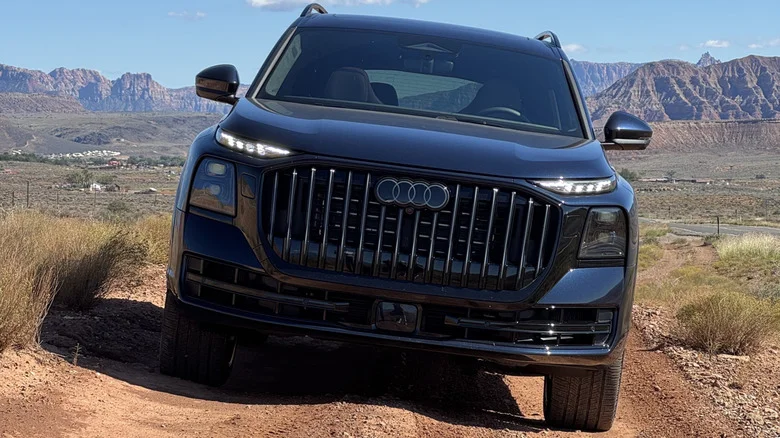
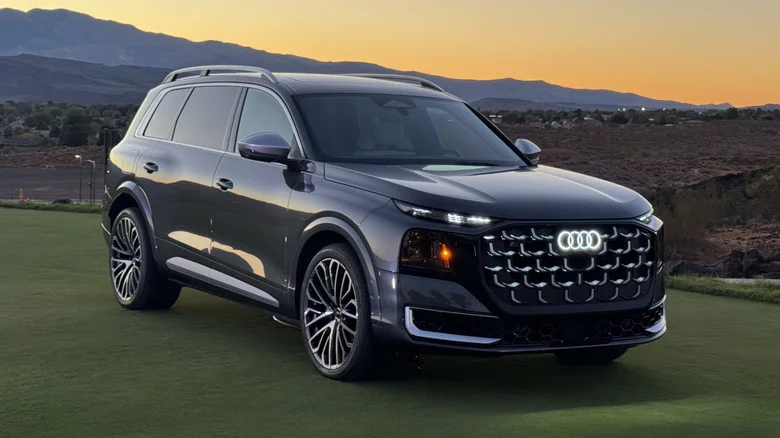
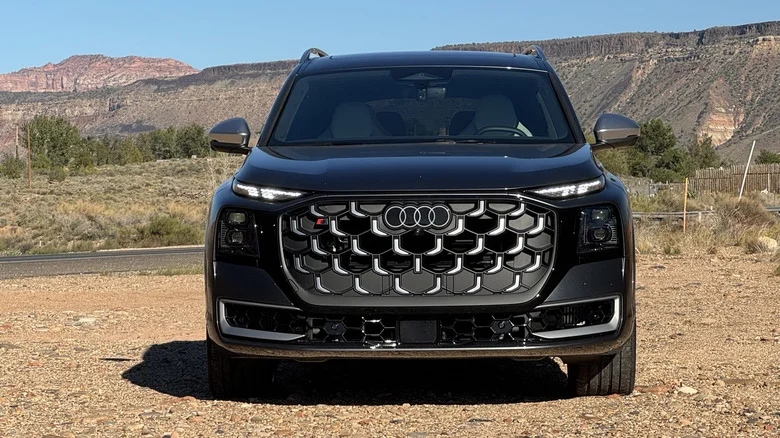
The two versions look closely related. Their most obvious distinction is the grille: the Q9’s upright design gives way to a more familiar mesh pattern on the SQ9. Inside, the differences are subtle. The engine and chassis setup do most of the work to separate them.
 Logan K. Carter/ Jalopnik
Easy to place on the road, despite its size
The Q9 felt far less imposing from behind the wheel than its dimensions suggest. It’s 3.6 inches longer and 1.6 inches wider than the Mercedes-AMG GLS I drove shortly before, yet the Audi felt more like a large wagon than a bulky SUV. The Prestige package on my test car included four-wheel steering, which turns the rear wheels by up to five degrees. At low speeds that tightens the turning circle; at higher speeds it helps with stability. In parking lots, the system made the Q9 feel surprisingly manageable.
On winding roads, the SUV remained composed and responsive. The steering felt direct, and the Q9’s 5,302-pound curb weight is relatively modest for this class. I could hustle it through turns without constantly being reminded of the mass. The result is an unusual combination: a full-size family vehicle that responds more like a car than a traditional large SUV.
The V6 has plenty of muscle for the job, including uphill driving at an altitude of 10,000 feet. At low engine speeds, there’s noticeable turbo lag, but once the turbos are working, the engine pulls smoothly and confidently. The standard Q9 also gets six-piston front brake calipers and 15.7-inch front rotors. They provide strong stopping power, though a firm brake application can send loose items sliding toward the front of the cabin.
I didn’t initially feel a need for the SQ9’s additional power. That changed when I drove it. The V8 doesn’t make its extra 162 hp and 148 lb-ft obvious in every moment, but use launch control and the difference becomes unmistakable. The procedure requires Dynamic mode and a press of the traction control button to select Sport Traction. My first attempt missed that setting and felt underwhelming; the next made the SUV’s full force clear.
Audi says the 5,556-pound SQ9 can reach 60 mph in 3.8 seconds. With launch control engaged, it surged through the gears hard enough to make me laugh out loud. The acceleration feels startling in a vehicle this large, and it’s easy to imagine passengers being surprised by it. For buyers who only need a comfortable family SUV, the Q9’s V6 is more than capable. The SQ9 is for people who want serious performance alongside the space.
Logan K. Carter/ JalopnikThe SQ9 also feels markedly sharper in corners. On tight, empty mountain roads, it held its line with no noticeable tendency to push wide. Standard four-wheel steering helps it turn, while its sport-tuned adaptive air suspension keeps body lean in check. Audi says the rear differential and Quattro setup allow more oversteer, but I didn’t get a chance to test that claim. What I did feel was a large SUV that changed direction with the composure of something much smaller.
Its brakes suit the performance, too: six-piston calipers clamp 16.5-inch front discs, and the pedal feels firm with little initial softness. The SQ9’s stopping response is strong enough to feel almost abrupt until you adjust to it. Compared with the Mercedes-AMG GLS63 I drove recently, the Audi felt more capable on the winding roads we used. Both are high-performance three-row SUVs, but the SQ9’s steering, suspension and braking made it the more involving drive for me.
Firm, controlled suspension with useful flexibility
Before the drive, Quattro development specialist Dieter Weidemann said Audi didn’t want to give the Q9 a “flying carpet ride.” That description set expectations for a firm setup, but the suspension never felt harsh. Even on 22-inch wheels, the standard Q9 rode with a taut, athletic character that suited its steering and handling. It was more settled on the road than the phrase “firm ride” might imply, especially once I picked up the pace.
The SQ9’s adaptive air suspension has a broader difference between Comfort and Dynamic settings. In Comfort, the ride felt much like the Q9: controlled and firm, without becoming unpleasant. Dynamic noticeably tightens the setup, making rough pavement busier through the cabin while keeping the SUV flatter in corners. Drivers choosing the SQ9 get a meaningful change in character between those settings, rather than a single compromise tuned for every situation.
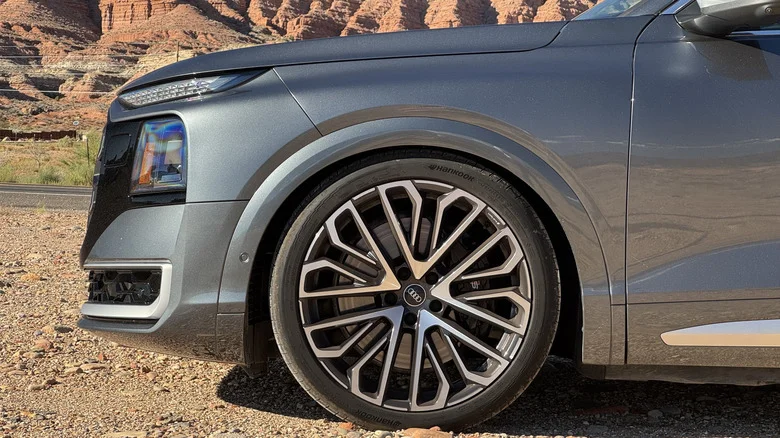
Highway noise was less impressive. Wind noise stayed well contained, but some road surfaces generated more tire and pavement sound than I expected. The large wheels may contribute. The Bang & Olufsen stereo sounds excellent, and the front seats’ massage function made long stretches easier, but those comforts don’t fully hide the noise on coarse pavement.
Cabin technology is mostly clear and useful
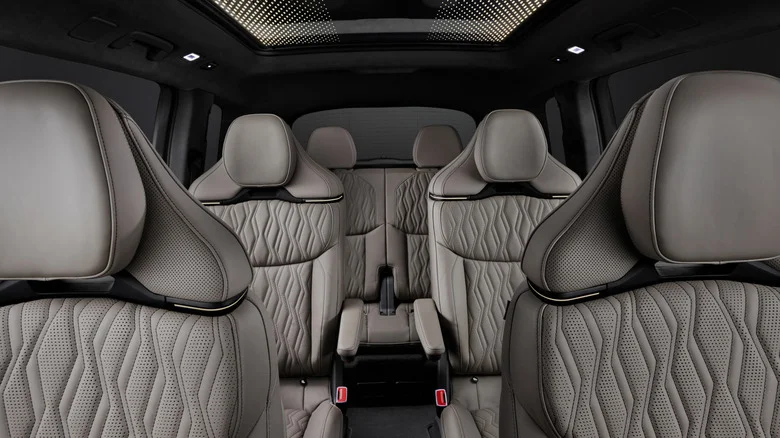
The Q9’s front seats offer extensive adjustment and an effective massage function. My test car also had a large electrochromic panoramic roof with integrated ambient lighting, though Audi said the lighting feature would be delayed on production cars. I found that addition excessive rather than essential. The 4D Bang & Olufsen system adds seat-bottom vibrations that follow the bass. It’s an entertaining novelty, but I’d happily keep the sound system without the extra sensation.
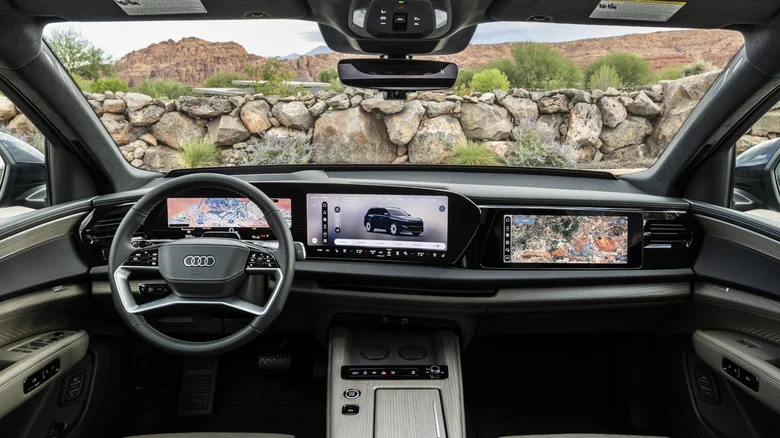
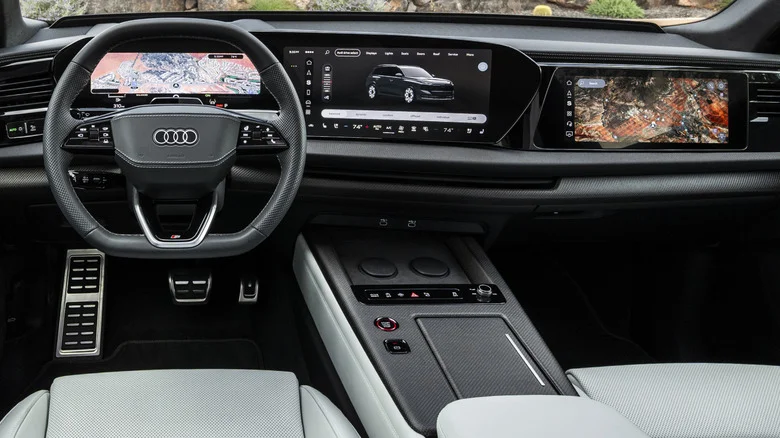
The infotainment setup includes a 14.5-inch central touchscreen and a 12.3-inch display for the front passenger. Audi’s latest MMI software is logically arranged and easy to learn. The passenger display feels less necessary, though it did let me adjust my massage settings while I was driving. One awkward detail: the front passenger’s side and thigh bolsters can only be adjusted through the central screen, which is angled toward the driver. Reaching across to operate it is inconvenient, particularly when the passenger has a screen of their own.
Once past that irritation, the system works well. The central screen is generously sized, the menus are easy to browse, and the dashboard includes a ledge that helps steady a hand while using the touchscreen. There are three screens across the front cabin, but the overall layout doesn’t feel as cluttered as that number might suggest.
The Q9 also introduces Audi’s first hands-free highway driving feature, Adaptive Cruise Assist Plus, available on Premium Plus and Prestige trims. It works on divided highways and is broadly similar to systems such as Super Cruise and BlueCruise. Two white lights and a message in the instrument display show when the system is available. To activate it, the driver simply releases the steering wheel, and the lights turn green.
That activation method is easy to use, but it also caught me off guard. When I wanted to take control near a construction zone, the system switched on as soon as I adjusted my hands on the wheel. It handled much of the drive well, though recently altered lane markings and construction areas caused some confusion. It remains a Level 2 driver assistance system, so the driver must remain responsible for the vehicle. I appreciated how quickly it could take over on suitable stretches, but the activation cues could be clearer.
Materials and space feel suited to a flagship
The Q9 and SQ9 interiors largely meet the standard set by Audi’s best older cabins: the controls, seats and trim feel carefully finished and appropriately expensive. One exception is the padded fabric on the touchscreen ledge, which feels noticeably cheaper than the surfaces around it. The SQ9’s carbon basalt structure inlay is a welcome alternative to conventional glossy carbon fiber. Its matte surface has a distinctive texture and doesn’t show fingerprints easily.
Both test vehicles had the Luxury package, which adds a suede-like Dinamica headliner and extended leather across the dashboard, upper doors, center console and armrests. That equipment shapes the impression of cabin quality, so I can’t say whether lower trims will feel as plush. Buyers should check the materials in the specific version they’re considering.
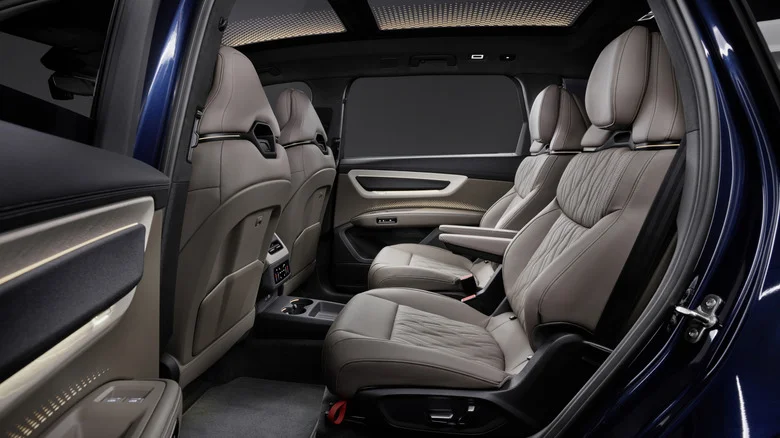
AudiThe Q9’s added length primarily benefits second-row passengers. Front-seat room is similar to the Q7, but there’s ample space even for a very tall driver. The second row gains 2.3 inches of legroom over the new Q7, and I found it comfortable even behind my own driving position.
Third-row figures need a little context. The Q9 has 29.1 inches of published third-row legroom, the same as the Q7, but offers 1.5 inches more headroom. Audi says the legroom measurement is taken with the second row in its rearmost position. Since the Q9’s second-row seats can move two inches farther back than the Q7’s, moving them forward creates more space for third-row passengers. An Audi spokesperson described the Q9’s third row as more accommodating, citing the extra headroom and improved knee room.
In practice, I found the third row low to the floor, with a knees-up posture that would become uncomfortable on a long trip for a tall adult. Headroom was reasonable, and smaller adults or children should find it more usable. The second row is the better place to spend time, while the third row adds useful flexibility when the family needs all seven seats.
Cargo space is more generous than in the Q7. With the third row in use, the Q9 offers 19.3 cubic feet, 4.2 cubic feet more than the smaller model. Fold the third row and capacity rises to as much as 50 cubic feet, depending on seating configuration. With both rear rows folded, there are 87.1 cubic feet—9.1 more than the Q7.
Logan K. Carter/ JalopnikPrice, equipment and the packages to consider
The Q9 Premium starts at $89,095, including destination. Its standard equipment includes digital gauges, the passenger display, adaptive air suspension, a surround-view camera system, adaptive cruise control with lane departure warning, automatic parking with acoustic sensors, ambient lighting, navigation and a Bang & Olufsen stereo. It also includes four-zone climate control, a head-up display, heated front seats and steering wheel, leather upholstery, a panoramic sunroof, a power tailgate, a power-folding third row and customizable exterior light signatures. Audi includes scheduled maintenance for three years or 30,000 miles.
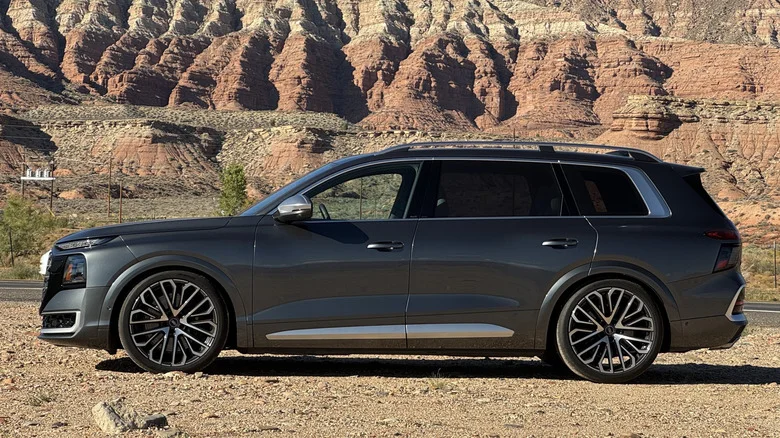
My Q9 test vehicle cost $111,895 with options. That price included the $14,700 Prestige package, the $2,800 Black Optic styling package, the $4,000 Luxury package, an $850 trailer hitch and $450 second-row captain’s chairs. The hitch supports up to 7,700 pounds of towing. The captain’s chairs are comfortable, but they don’t fold flat and reduce maximum cargo capacity.
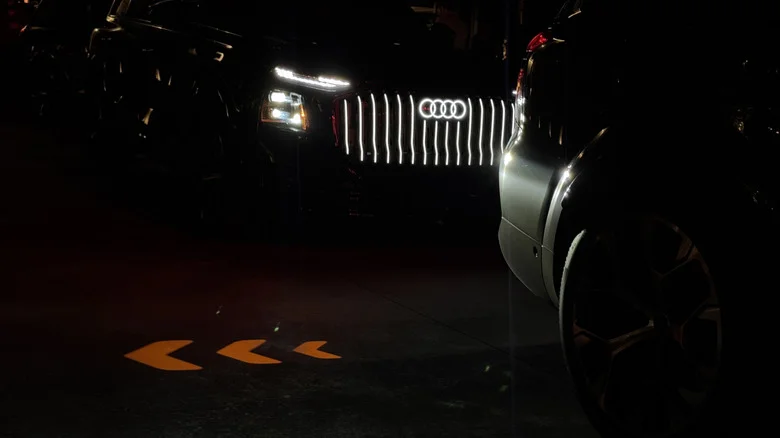
Prestige is the package that most changes the Q9’s luxury and convenience specification. It adds four-wheel steering, a 4D Bang & Olufsen system, curved digital OLED taillights, massaging Nappa leather sport seats, an electrochromic panoramic sunroof, an illuminated grille and additional ambient lighting. The Black Optic package is mostly a styling choice; I’d leave it off and spend money on features that affect day-to-day use.
One notable item is Audi’s digital matrix LED headlights, available in the United States for the first time on the Q9. Along with automatic glare-free high beams, they can project graphics onto the road, including orange arrows that indicate the direction of a turn.
The Luxury package’s powered doors are another unusual option. They opened reliably during my drive, and ultrasonic sensors helped them avoid nearby people and objects. The system could feel awkward when I needed to stand in the door’s path to reach the handle. Opening the doors through the myAudi app is another option, and the controls would likely become more familiar with regular use. For parents managing children and bags, powered doors may be a genuinely useful convenience.
There’s a trade-off buyers should understand: Q9s equipped with powered doors don’t have a mechanical interior door release. Audi says an integrated capacitor has been durability tested for a 15-year service life and is designed to alert the driver if service is needed. I’d want to understand the release procedure and consider how the doors behave in a power interruption before choosing that package.
A strong new Audi flagship
The Q9 brings Audi a larger, more spacious entry in a class where it previously lacked a vehicle of this size. It combines a polished interior, a useful second row, competitive cargo space and handling that keeps the SUV from feeling cumbersome. The third row is best suited to smaller occupants or shorter journeys, and the road noise on rougher surfaces is a minor weakness, but the package works well for families who need three rows regularly.
The SQ9 makes the lineup more distinctive. Its 591-hp V8, 3.8-second claimed run to 60 mph, firm brakes and remarkably composed cornering give it performance that few family SUVs can use every day but many enthusiasts will enjoy. Its ride remains civil in Comfort mode, while Dynamic brings a more focused feel for back roads.
Against the GLS, X7, Defender 130 and Lexus TX, the Q9 has its own visual character: less theatrical than the Mercedes, less unusual than the BMW and less upright than the Land Rover. It feels like a return to the sleek, driver-focused Audi style associated with the Q7, now applied to a larger vehicle with roomier ambitions. The redesigned BMW X7 is on the way, so the competitive picture may shift. For now, the Q9 looks like a persuasive new choice, and the SQ9 is the standout for buyers who want a three-row SUV that can genuinely entertain.