Porsche 911 Challenge Review: A $275,000 Track Car for New Racers
The 515-hp 911 Challenge is five seconds quicker than a road GT3, with track-focused hardware and driver aids aimed at making racing more approachable.
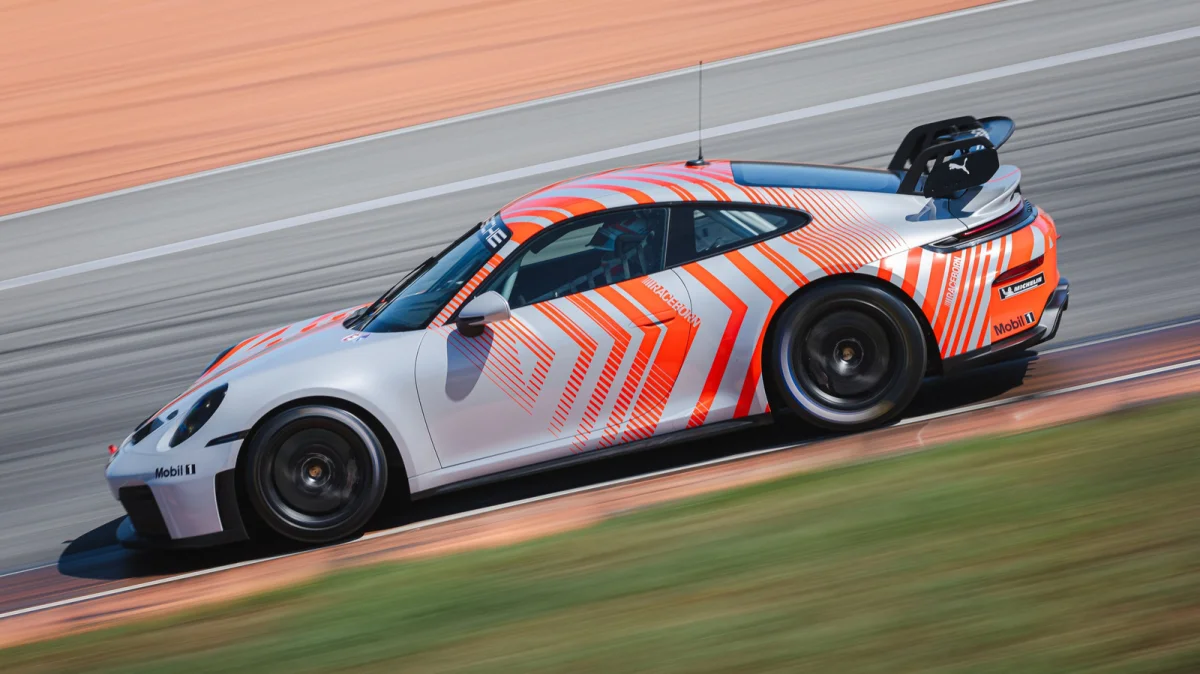
Porsche’s 911 Challenge fills a gap between a road car prepared for track days and a full competition machine. It’s built for drivers who want to start racing or spend more time on circuit without taking on the complexity of a high-strung car intended for a professional team. After driving it at Circuit Ricardo Tormo in Spain, the case for this middle ground looks strong: the Challenge combines a familiar GT3 foundation with meaningful track upgrades and electronic aids that remain useful at speed.
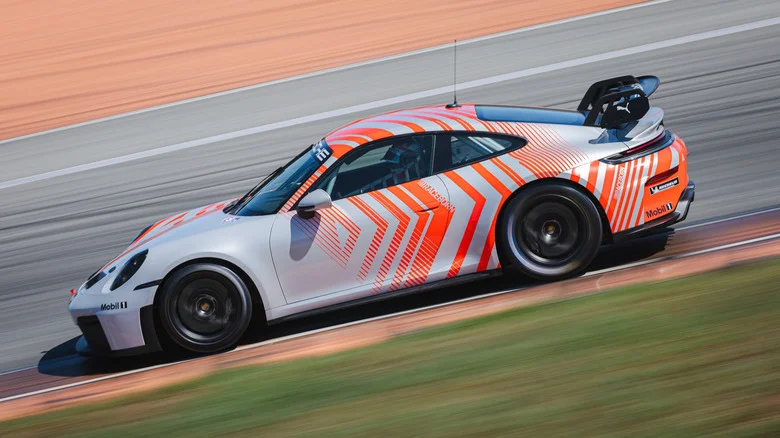
Porsche has built factory race cars such as the 911 RSR, 911 R, 911 Cup and 718 GT4 RS CS, but those cars are aimed at professional or experienced amateur teams. Keeping them running takes specialist mechanics, engineering support and a substantial budget. The Challenge is a different proposition: an entry-level, 911-based race car designed to make a first step into motorsport less demanding. It could also suit established track-day drivers who want a dedicated car instead of putting wear on a daily driver.
Disclosure: Porsche flew the author to Spain to drive the 911 Challenge at Circuit Ricardo Tormo.
GT3 foundations, with race-ready equipment
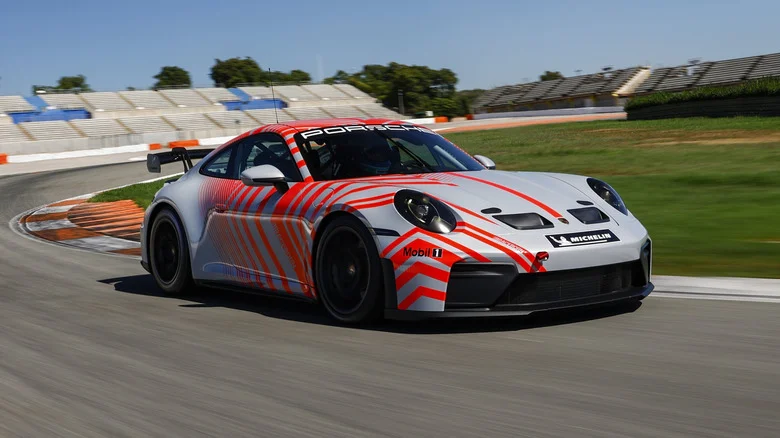
The Challenge is based on the road-going 911 GT3 and shares its engine, transmission, steering wheel, air conditioning, ABS and stability control, all modified for circuit use. That common hardware should make the car feel familiar to GT3 drivers, while reducing the number of unfamiliar systems a newcomer needs to learn. Porsche adds a four-way adjustable rear wing and air jacks, bringing practical race equipment into the package.
Its 4.0-liter engine produces 515 horsepower at 8,500 rpm, five more than the road GT3, and has a 9,000-rpm redline. Power goes through a seven-speed PDK dual-clutch transmission. Drivers can shift manually with the familiar paddle shifters or leave the gearbox in automatic mode. For someone learning circuit craft, the automatic setting frees up attention for braking points, traffic and car placement.
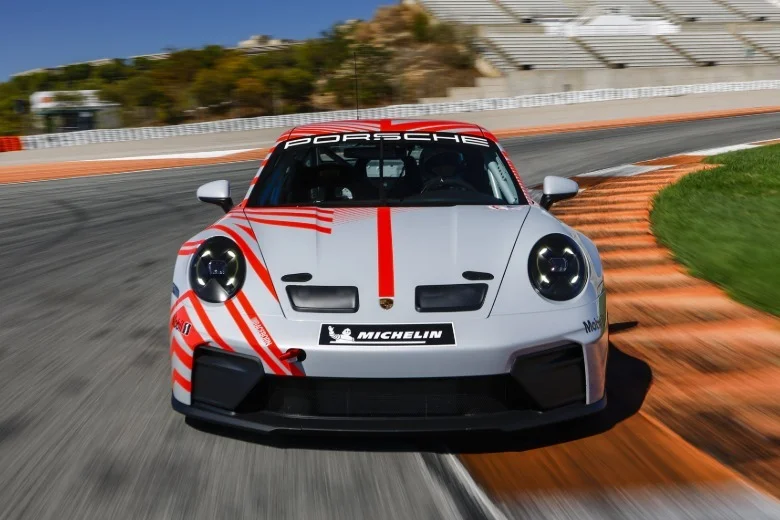
The Challenge also sheds 60 pounds compared with the road GT3. That difference and the modest power increase aren’t especially obvious from the driver’s seat; the more substantial changes come from the chassis, tires and braking setup.
Suspension springs and dampers are tuned for slick tires. The test car wore Michelin slicks, while Yokohama tires are expected to be specified for U.S. Porsche race series. Its 18-inch, five-lug wheels replace the center-lock setup used on the Cup car and road GT3. The wheels are shared with the new GT4R, as are the brakes, which use 14.9-inch rotors at both ends. A three-position adjustable anti-roll bar gives drivers room to alter the car’s balance without requiring a complex setup.
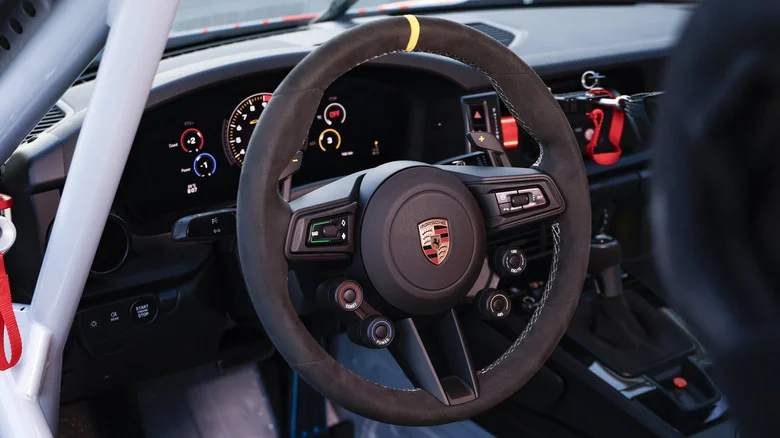
Safety and support are part of the package, too. The car has a welded-in roll cage, a racing seat with a six-point harness, a fire suppression system and a 29-gallon FT3 fuel tank. Porsche Motorsport sales chief Michael Dreiser says the goal is to help drivers get comfortable without a long learning curve. He describes the offer as a race-ready car backed by data acquisition, spare parts support and technical documentation.
More pace, without demanding more from the driver
At Ricardo Tormo, the Challenge felt like a more focused version of the road GT3. On the circuit’s tight, technical layout, it turned in more eagerly and reached the apex with less effort. The slick tires account for some of that extra grip, but the suspension appeared well matched to the available traction.
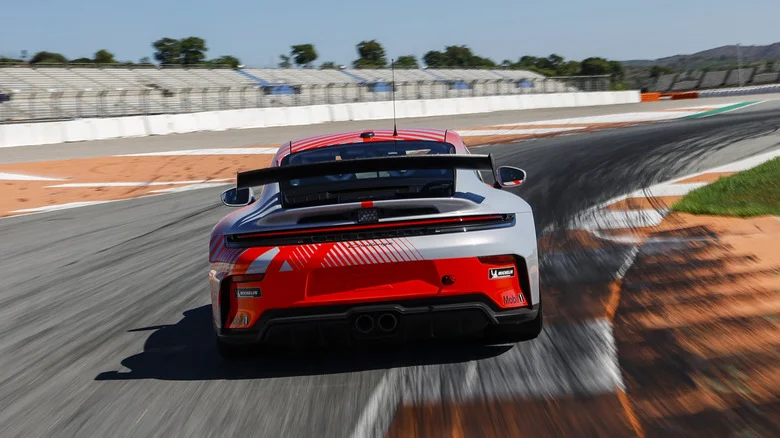
Braking stood out as another step forward. The initial response was stronger, and the motorsport-tuned ABS worked more naturally with the driver than the road car’s system. The stability control followed the same pattern: even with higher cornering speeds and greater lateral loads, it didn’t intervene intrusively. Switching it off allowed more freedom, but didn’t produce much quicker laps. The impression was that when the system did step in, it was likely helping rather than costing time.
The author drove the 911 Cup, the Challenge and the road GT3 during the same day. The Cup was the pace-setter, with no other car driven matching its lap time. The Challenge was about five seconds slower than the Cup, but around five seconds quicker than the road GT3. It’s a striking result for a car positioned to make circuit driving more accessible. The Manthey Racing “Grello” GT3R was also present, but the author didn’t drive it.
Price, running costs and availability
The 911 Challenge costs $275,000 landed. That’s a large purchase price, but the comparison with modifying a GT3 changes the calculation: the Challenge ran five seconds quicker per lap in this test. It was also 1.5 seconds quicker than a GT3 RS fitted with the Manthey Kit. That car was cited at about $361,155 before taxes, delivery and dealer installation.
Purchase price is only part of the cost of running a race car. The source’s assessment is that service, preparation and maintenance should be more manageable for the average customer with the Challenge than with more demanding competition cars. That matters particularly for new racers, who may find that a season’s running costs exceed the initial price of the car. Porsche’s parts support and technical documentation are relevant here, though the source doesn’t provide specific maintenance costs.
Porsche plans to prioritize customers intending to race in its Porsche Sprint Challenge and Sprint Trophy one-make series, while also making a number of cars available to track-day customers. For the latter group, the Challenge’s strongest appeal is its combination of speed and approachable controls: it’s fast enough to deliver a substantial step beyond a road GT3, yet its transmission, ABS and stability control can help reduce the workload as drivers build experience. At $275,000, it remains a serious commitment, but Porsche has given track-day drivers a clear route from road-car pace toward competition performance.